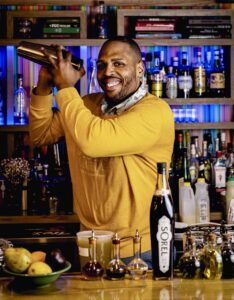
Bartender and columnist Khalid Williams. Photo by Bread and Beast Photography, provided by Khalid Williams.
By Khalid Williams
Spring is one of the hardest times of year to plan for behind the bar because it never really picks a side. One week still feels like winter. The next week feels like patio season. Then it rains for four days straight, and Connecticut starts acting like it’s the Pacific Northwest. That kind of inconsistency is not a side issue for bars. It affects what people want to drink, how they feel when they walk in, and how well your menu is actually working in real time.
That is why smart goals matter this time of year.
I do not mean “smart goals” in the corporate poster sense. I mean goals that make sense for your bar, your staff, your costs and your guests. Goals that are practical. Goals that can actually survive service. Spring has a way of exposing whether your bar program is flexible or just hopeful. The bars that do well are not the ones chasing every single weather shift, and they are not the ones refusing to change out of pride. They are the ones that can balance creativity, hospitality, and business.
That balance matters because the pressures are still real. Staffing is still a problem in plenty of places. Product can still be harder to get than it should be. Prices are still moving around. A garnish, a modifier, a case of fruit, a case of glassware loss, all of that adds up. At the same time, guests are feeling their own pressure. They may still want to go out, still want a great experience, still want a cocktail that feels worth it, but they are watching what they spend too. So the question is not just, “What do we want to put on the menu?” The real question is, “What can we execute well, sell confidently, and stand behind?”
One smart goal for spring is to make your menu nimble without making it feel unstable.
That is an important difference. A nimble menu can move with the season. It can absorb a warm stretch, a cold snap, a rainy week, a price increase, or a product outage. An unstable menu feels random. It feels like the bar is guessing. Guests may not always be able to articulate that feeling, but they know when a menu feels grounded and when it does not.
That is one reason classic cocktails matter so much right now. Classics are the safe landing place for any thoughtful bar. That does not mean you give up personality. It means you give yourself structure. A bar that knows how to lean on a Daiquiri, a Collins, a Margarita, a Negroni or a whiskey sour variation has given itself room to adapt. Those drinks can still feel seasonal. They can still feel intentional. They can still feel elevated. But they are also easier to repeat, easier to train, and easier to cost out than some overbuilt seasonal swing for the fences.
That matters because one of the most important smart goals behind the bar is figuring out how to protect your margins without making the guest feel like they are being “cheaped out” of a better experience.
That is where some operators get into trouble. On paper, a business choice may be absolutely correct. Maybe the garnish that costs eleven cents a drink needs to go. Maybe the nice fresh citrus expression becomes a dried lemon wheel. Maybe a drink gets streamlined because the prep is beating up the team and the juice is not worth the squeeze. Those can all be correct decisions. But if you do that work with no thought for presentation, no conversation with your staff, and no plan for how the drink still feels special, then a smart operational move starts to look like a cheap guest experience.
And guests notice. In a bar, hospitality always interprets the business decision. A guest is not standing there thinking about cost of goods sold. They are looking at the glass in front of them and deciding whether your bar still feels thoughtful. If a drink still looks intentional, still tastes balanced, and is still presented with confidence, people are usually willing to go with you. If it looks stripped down, half-explained, or carelessly edited, they are going to feel it.
This is where our business tends to split into camps. On one side is the operator who says the only thing that matters is protecting the bottom line. Raise prices. Cut garnish. Cut labor. Cut options. Tighten everything up. On the other side is the artist who says, “I’m not changing my menu. I’m not adjusting anything. We have to protect the integrity of the guest experience no matter what.” The problem is that bars cannot survive living completely in either mindset. Business matters. Integrity matters. Hospitality sits right in the middle and asks you to do both well.
The better approach is balance.
Keep a sharp eye on the drinks that define who you are as an establishment. Most bars have one. It is the seasonal showpiece, the signature cocktail, the drink with the extra thought in it. That drink matters. It tells your guests something about your point of view. But now ask the harder question: how does that drink stay sustainable? Can the prep be tightened up? Can the garnish be refined? Can the drink still feel like itself while becoming more profitable and more realistic to execute?
Then support that drink with choices that are durable. Lean into classics or classic-adjacent drinks that still feel a cut above the rest, but are repeatable, less perishable, and less expensive to produce. Those drinks do real work for a bar. They create consistency for the team. They create value for the guest. And they allow you to put extra energy where it matters most instead of exhausting the whole program trying to make every drink a statement piece.
A smart spring framework can be simple: Set one creative goal, one cost goal and one service goal. Refresh two drinks for the season. Reduce waste on fruit and garnish. Retrain staff on how to explain menu changes with confidence. That is real progress. That is a bar program that pays attention.
Spring does not reward rigidity. It rewards awareness. Watch the weather. Watch guest behavior. Watch your costs. Watch what your team can really handle on a slammed Friday night. The smartest goals behind the bar are not always the flashiest ones. They are the ones that keep you profitable, seasonally appropriate, and still recognizable as yourself. That is smart bar work.
Khalid Williams is a Connecticut-based bartender, beverage director and writer behind “The Barrel Age.” A winner of numerous accolades, he’s worked across the three-tier system. His mission is to speak the truth about drinks, culture and community with sharp, soulful hospitality for modern drinkers. Follow his weekly drinks content at drinkthebarrelage.com.