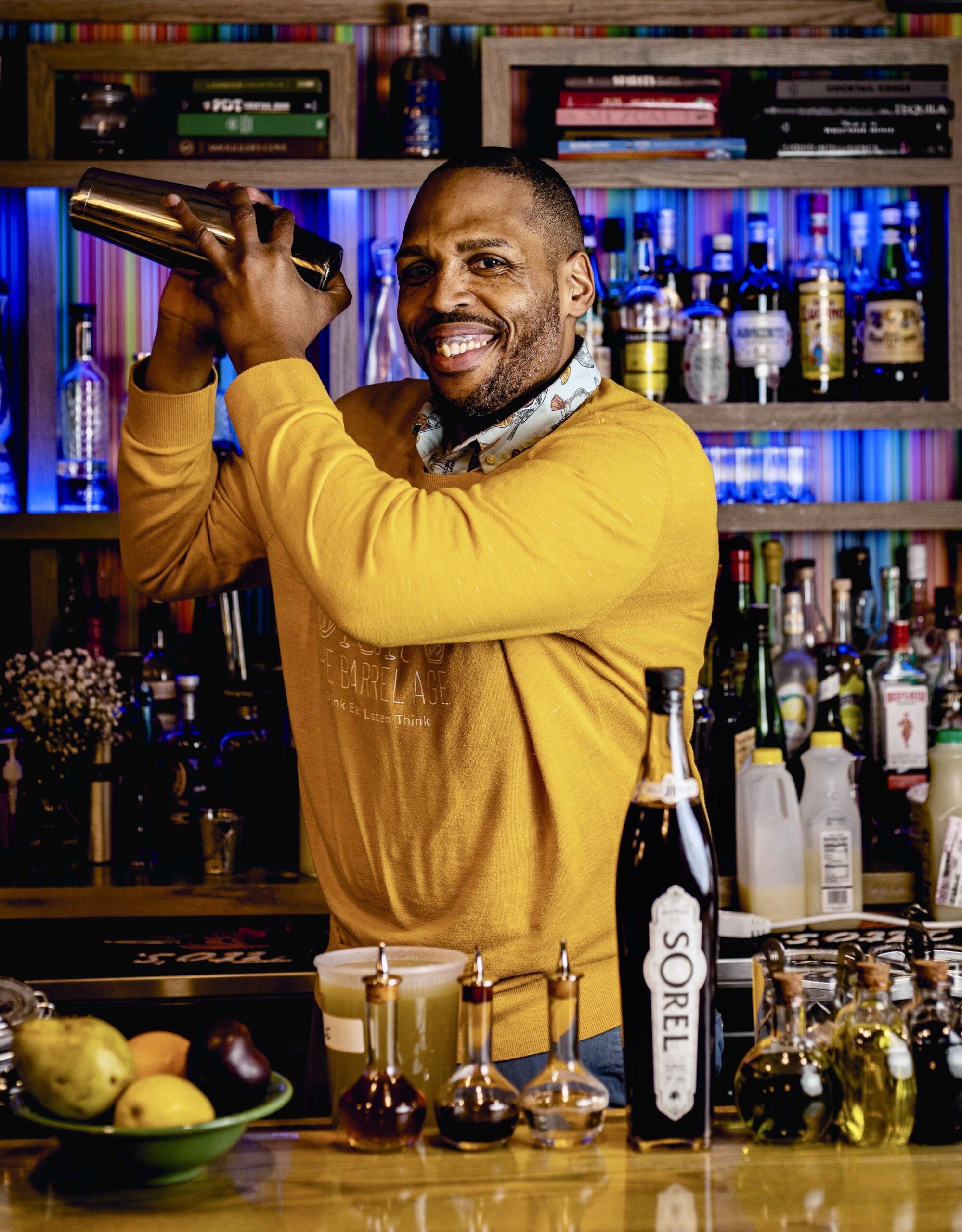

Bartender and columnist Khalid Williams. Photo by Bread and Beast Photography, provided by Khalid Williams.
By Khalid Williams
I’ve spent most of my adult life on every side of the three-tier system—slamming tickets on a Friday night, riding along with reps, sitting in supplier meetings where “menu strategy” gets reduced to a slide deck. I’ve watched awards pile up for programs that look great in photos and feel terrible in real life. If you’ve ever opened your own cocktail menu, felt your eyes glaze over, and wondered who exactly you built it for, this one’s for you. I’ve been a part of the problem of self-congratulatory glut and this piece is meant to attempt to serve up a solution.
When 45-Drink Menus Were a Flex
There was a whole era where the homework assignment for “serious” cocktail bars was clear: 40-plus drinks, every classic, every riff, house everything. You know the script: Every spec from Aviation to Zombie; house infusions, house bitters and house syrups in five flavors; and Smoked Old Fashioneds, clarified Milk Punch, fat-washed whatever. On paper it was impressive. In a magazine feature, it looked like success.
On a Saturday night, it was a slow-moving car crash. Prep turned into a second job. One bartender lived in the walk-in, one lived at the stove, and the dish pit never stopped. Half the bottles on the back bar moved once a week, but you had to keep them because what if someone finally orders that one drink? We didn’t do this because we’re dumb. We did it because we were trying to prove we belonged; prove to guests we were “worth” those $15–$18 prices; prove to brands we could play on the national stage; and prove to ourselves we weren’t “just” a neighborhood bar.
In busy markets, and especially in smaller ones like Connecticut and Rhode Island, that insecurity hits harder. You feel like you have to make up for not being in London or New York City by offering everything. And that’s how you end up with a menu that looks like a novel and works like a punishment.
The Data Is Boring. Boring Pays the Rent.
Here’s the reality check nobody likes to hear: the hits are the hits. Look at any recent on-premise data set or “most ordered cocktails” list and the same crew shows up over and over: Margarita; Espresso Martini;
Negroni; Spritz; and Mojito. Global “Top 100 cocktails” lists? Same story with a twist: Porn Star Martini, Spicy Margarita, French 75, and the disco kids—blue drinks, Appletinis, all the stuff craft bars used to sneer at—are
all surging.
Translate that into plain language: The “trend” isn’t endless novelty. The real trend is new classics settling in next to the old ones. People are not walking into your bar asking for your fifteenth house Negroni riff named after an inside joke from staff meal. They’re walking in wanting something recognizable, easy to order and easy to love. And they’re completely fine if that “something” is a Margarita with a twist, a French 75 with local bubbles, or a Porn Star-adjacent sour that just happens to slap.
The New Serious Bar Has Fewer Drinks, Not More.
Look at the bars getting respect right now—the ones bartenders talk about when they travel, the ones writers keep profiling. A pattern shows up: Nine to 12 cocktails max; every drink is a riff on something guests already understand: sour, spritz, Old Fashioned, highball; and flavors get wild, while formats stay simple. You might see a clarified highball that drinks like a Tom Collins dressed in local produce; an Old Fashioned built on a base you’ve never heard of but still stirred, boozy, and brown in the glass; or a spritz that leans tropical, bitter, or savory—but still reads as “spritz” at a glance. That’s the new serious: fewer options, tighter focus, and a lot of discipline hiding under the fun.
What a Bloated Menu Really Costs You.
Now drag this back home. In New England, a huge, bar-nerd menu doesn’t just cost you time. It costs you survival. Here’s what a bloated menu looks like from the office: Overlapping SKUs sitting dead on the shelf—two gins that do the same job, three passionfruit products, four amaros that never make it into the well; prep days that feel like you’re running a commissary kitchen more than a bar: dehydrating, vacuum-sealing, clarifying, batching five drinks almost nobody orders; and new hires drowning in recipes. They nail two shifts of training, then get thrown into the deep end and melt down when three different “house tiki” drinks hit the ticket at once.
Picture two places on the same Saturday: A suburban sports bar outside Hartford with a cocktail book—thirty-plus drinks, infusions, crushed ice, TikTok tricks, three bartenders on, one calls out; or a city spot in Providence with a one-page menu—twelve drinks, all built from a shared backbone of syrups, juices, and base spirits, same call-out, same volume. Who survives that night with fewer comps, fewer walk-outs, and staff who still want to come back tomorrow? It’s not the bar with the novel in a leather menu cover. It’s the bar that edited.
My Rule: 70% of Sales, 12 Drinks Max.
Here’s the doctrine I work from now: If more than 70% of your sales come from 10 drinks, your menu should probably have 12, not 32. That doesn’t mean you only serve the obvious stuff. It means you build intelligence into the obvious stuff and keep the rest on a tight leash. A practical version:
- Anchor your menu in 5-6 global winners: Margarita, Espresso Martini, Spritz, Old Fashioned/Manhattan family, one or two tropical sours. Give each of them your spin—local fruit, regional spirits, seasonal bitters—but keep the bones familiar.
- Add 4–6 house signatures that actually say who you are. Connecticut orchard fruit, New England berries, Rhode Island shoreline ingredients, local coffee roasters, regional spirits. Drinks that can’t just be copy-pasted to another city.
- Make everything share components. If you need a one-off syrup that only works in one drink, ask yourself if that drink has really earned its spot. Batching should feel like stacking Lego bricks, not reinventing the wheel every Thursday.
Do that, and suddenly your line can move, your prep day shrinks, your ordering makes sense, and your bar team has mental space for actual hospitality, instead of just spec-recall panic.
The Real Flex in 2026.
We’ve all seen the bar flexes that aged badly, which includes the 20 obscure Amari brands that nobody touches, a “tiki” section that’s really just sugar and appropriation in a ceramic mug or menus so dense nobody has the energy to read past page one. That era is over.
In 2026, the flex isn’t how many bottles you can list. It’s about how quickly and consistently your team can execute under pressure, how clearly your menu tells guests who you are in one glance and how calm your bartenders look at 9:30 p.m. on a slammed Friday.
Smaller menus don’t make you less serious. They make you more accountable. Every drink has to earn its place—on the menu, on the ticket, in your prep, and in your staff’s brain. Cut the noise. Keep the hits. Let your team breathe. Your guests, your dishwashers, and your P&L will all say thank you—whether they know why or not.
Khalid Williams is a Connecticut-based bartender, beverage director and writer behind “The Barrel Age.” A winner of numerous accolades, he’s worked across the three-tier system. His mission is to speak the truth about drinks, culture and community with sharp, soulful hospitality for modern drinkers. Follow his weekly drinks content at drinkthebarrelage.com.