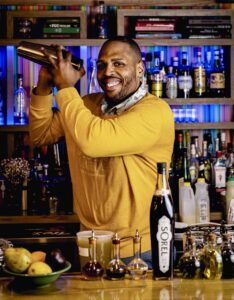
Bartender and columnist Khalid Williams. Photo by Bread and Beast Photography, provided by Khalid Williams.
How Bars Can Honor Sober October
By Khalid Williams
There is a strange assumption floating around the beverage business every October. If we take Sober October seriously, are we supposed to stop selling booze? Of course not.
A steakhouse does not dishonor vegetarians by selling steak. A coffee shop does not betray the decaf drinker when somebody orders a double espresso. Hospitality is not about forcing the entire room into the same choice. It is about making each choice a good one.
That means bars should absolutely continue selling Martinis, Manhattans, Champagne, añejo tequila and that beautiful bottle of Burgundy collecting dust on the third shelf during Sober October. We just might need to sell them differently.
For years, much of the alcohol business operated on a fairly uncomplicated equation: more drinks equals more money. Happy hour. Another round. Doubles. Bottomless whatever. Get people in, keep the glasses full and let volume do the work. The consumer is changing that equation for us.
NIQ reports that 62% of consumers are now moderating their alcohol consumption. But moderation does not necessarily mean that those consumers have stopped drinking. In the same research, 55% said they would still pay more for a better-quality drink. Given a fixed amount of money, 63% said they would choose one or two high-quality drinks instead of four or five standard ones.
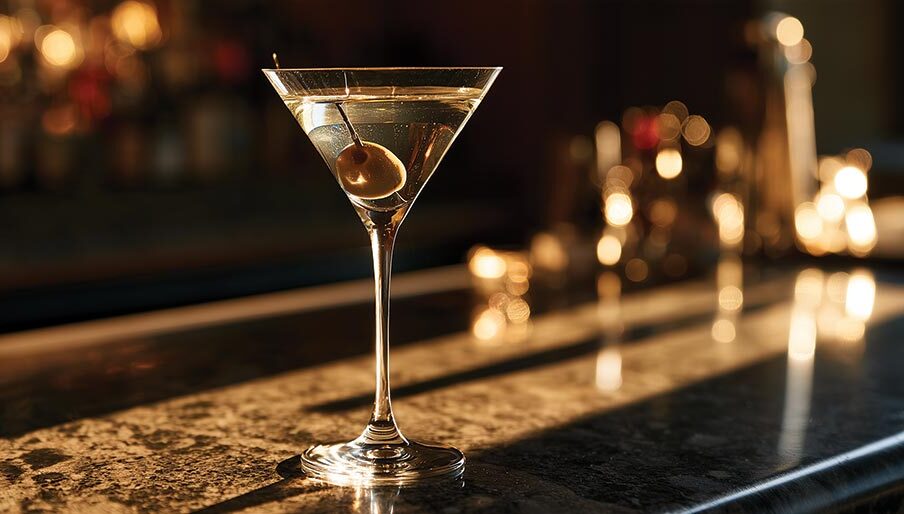
Read that again if you make your living selling alcohol. People drinking less does not automatically mean people caring less about drinks. It may mean exactly the opposite. If somebody plans to have one Martini tonight, that Martini suddenly matters a hell of a lot. Make it cold. Make it balanced. Give them good gin. Use fresh vermouth. Put it in a beautiful glass. Tell them why the olive is there. Make the drink worth choosing.
Sober October can therefore become a month when we stop asking, “How do we get people to drink more?” and ask a better question: “How do we make the drinks they choose matter more?” There is money in that question. One answer is size.
Mini martinis, half-pours of wine, small-format Negronis and tasting flights are moving beyond novelty. NIQ has identified smaller serves as a significant 2026 on-premise trend because they allow guests to experience premium ingredients, try more things and manage both price and alcohol consumption.
That is moderation without deprivation. A guest might not want two six-ounce glasses of wine with dinner. Fine. Sell them three thoughtful three-ounce pours paired with three courses. They learn something. You sell something. Your beverage program gets to show off. Everybody wins.
The same principle works behind the cocktail bar. Give someone a beautifully made half-size Bamboo before dinner, a full-strength cocktail with the entrée and an alcohol-free drink afterward. Suddenly Sober October has not destroyed the three-drink experience. It has redesigned it.
Food pairing presents another enormous opportunity. Rather than selling alcohol primarily around intoxication or “getting the party started,” put the attention back where beverage professionals claim it belongs anyway: flavor.
Why does this amontillado work with the mushrooms? Why does the acidity in this Riesling make that fatty pork dish taste better? Why does the bitterness of Campari suddenly make sense when there is salty food on the table? Now the alcohol is not merely a unit of consumption. It is part of an experience. And this is where the industry has to be careful.
Honoring Sober October cannot mean putting a zero-proof section on the menu while teaching the staff to steer everyone toward alcohol because the check average is better. Guests can smell bullshit. Give the guest who is not drinking something genuinely exciting. Give the guest who wants one drink the best drink you can make. Give the guest who wants three drinks three drinks responsibly. The trick is not deciding for them.
It is removing the penalty for whichever decision they make. There is also something wonderfully old-fashioned about this approach. Long before anybody said “sober curious,” drinking culture contained aperitifs, digestifs, session beers, spritzes, sherries, cobblers and other drinks designed around time, food, place and pace.
Not every drink was supposed to knock your hat sideways. Somewhere along the way, we confused abundance with hospitality. Sober October gives us an excuse to correct that. Run the Martini special but offer a miniature version. Host the whiskey tasting, but make it educational, measured and accompanied by food. Create a wine flight that lets somebody explore three regions without consuming three full glasses. Put an excellent low-ABV cocktail beside the 0.0 percent drink and the barrel-strength bourbon. Build a menu that behaves more like a volume knob than an on/off switch. Because moderation is not the enemy of the alcohol business. Bad alcohol experiences are. The person who remembers one extraordinary drink, good food, a bartender who taught them something and a night when nobody pressured them?
They come back. They bring people. They trust you. And trust may ultimately be the most profitable drink on the menu. So yes, honor Sober October.
Stock the alcohol-free beer. Make the zero-proof cocktail. Celebrate somebody who decides October is their month away from alcohol. And then make the best damn Martini you know how to make for the person sitting next to them.
Those two ideas were never enemies. That is just hospitality.
Khalid Williams is a Connecticut-based bartender, beverage director and writer behind “The Barrel Age.” A winner of numerous accolades, he’s worked across the three-tier system. His mission is to speak the truth about drinks, culture and community with sharp, soulful hospitality for modern drinkers. Follow his weekly drinks content at drinkthebarrelage.com.