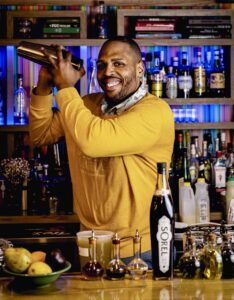
Bartender and columnist Khalid Williams. Photo by Bread and Beast Photography, provided by Khalid Williams.
By Khalid Williams
If you’ve worked more than a couple of years behind a bar, you know the calendar better than any planner app. January and February get weird business cycles. It’s gift card season, after all. Patio season hits like a switch. Holiday season feels endless until it suddenly isn’t. Most of us just survive those swings. But if you zoom out, the seasons are the best training tool you’ve got. The bar doesn’t run on a straight line and neither should your education plan.
Look at winter. Guests want hot drinks, deeper flavors, and comfort-toddy builds, spirit-forward stirred, richer textures. Imbibe is full of winter recipes built around pomegranate, baking spices, toddies, and hot cocktails that lean on whiskey, brandy, aquavit and fortified wines. The “Difford’s Guide” massive recipe library tells the same story if you filter for “winter” or “hot” serves: Heavier builds and slower sips dominate.
That’s not just menu inspo. It’s a training priority list. Winter is when you make sure every bartender on your team can: Build a stirred drink properly; handle hot cocktails safely and consistently; and talk about dark spirits and fortified wines without bluffing.
Then take that one step further. Difford’s has been saying for years that cocktail menus should only list drinks every bartender is confident and proficient at making. Diageo’s seasonal menu guidelines add another layer: Size your seasonal offering to the actual time and ability of your staff, not your ego.
Put those together and winter becomes “deep work” season: Fewer covers, more time to drill technique and product knowledge so that by summer you’re not praying the new hire can remember how to build a Boulevardier.
Spring is a different animal. Citrus is still king, but guests start looking for lighter textures and signs of life in the glass-green herbs, floral components, fresher garnishes. This is a perfect time to train on: Shaking technique and aeration; fresh juice management and waste reduction; and building low-ABV and sessionable drinks for the guests who are over winter but not ready to go full tiki.
Imbibe profiles bartenders who treat spring as creative “reset,” time-testing new specs, workshopping ideas with regulars, soft-launching drinks before they hit a printed menu. If you treat those months as a lab, not just a holding pattern before patio season, your team walks into May already fluent in the flavors they’re about to sell all summer.
Summer is execution season. Whatever romance you had about education goes out the window if the well is three deep and you’re in the weeds by 7:30. That doesn’t mean training stops; it just changes shape. The best training programs in the world, whether they’re big-brand academies like Bols or Bacardi’s trade schools, or the Be At One style eight-week bootcamps, all share one trait: They drill systems until they’re automatic. Summer is when you lean into that. Lock in station setups and enforce them; run short, focused pre-shifts: three talking points, one quick drill, done; and audit your menu against reality-any drink that can’t survive a Saturday should be reworked or cut.
In July, “training” might just be making every bartender on the team run the same six core builds for 15 minutes before doors. It’s not sexy, but neither is watching a new hire implode on tickets because you never gave them reps at speed.
Fall is where reflection belongs. When patio traffic slows and holiday insanity hasn’t started yet, you actually have time to zoom out and ask: What did we sell the most of this year, season by season? Where did we see the biggest training gaps-classics, batching, wine, NA? Who on the team stepped up as a natural educator, and who needs more support?
Writers like Wayne Curtis and the folks Imbibe highlights in their “Bartender for Life” coverage all circle the same idea: Longevity behind the bar comes from periods of recalibration, not endless grind. If you don’t build that into your year on purpose, the industry will do it for you, usually in the form of burnout and turnover.
So, what does a seasonally intelligent training plan actually look like for a bar in Connecticut or Rhode Island? It might be as simple as:
Jan.–Feb.: Classic builds and dark spirits bootcamp. Everyone learns the house specs for Old Fashioneds, Manhattans, toddies, and your full stirred section cold.
Mar.–Apr.: Citrus, spritz, and low-ABV. Focus on shaking, fresh juice, and light, bitter builds that will carry into patio season.’
May–Aug.: Systems and speed. Daily micro-drills, cross-training on stations, menu pruning to protect your team.
Sep.–Oct.: Product knowledge and cross-training: wine, beer, NA, new spirits. Bring in reps and educators when you can; borrow tactics from structured programs like the Bols Academy or regional trade schools if you can’t.
Nov.–Dec.: Holiday execution and retention. Teach batches, punches, and large-format serves so your bartenders aren’t hand-building Eggnogs while the door line grows.
None of this is theory for theory’s sake. Seasonal training does three things: It takes pressure off your busiest months, it gives your staff a reason to stay and grow, and it makes your menu believable because you’re only printing drinks your team has actually had time to master. The seasons are coming whether you plan around them or not. If you use them on purpose, you’re not just changing drinks with the weather; you’re building a bar team that’s a little stronger every time the calendar flips. In a business where “thriving” often just means “still here,” that’s the only trend that really matters.
Khalid Williams is a Connecticut-based bartender, beverage director and writer behind “The Barrel Age.” A winner of numerous accolades, he’s worked across the three-tier system. His mission is to speak the truth about drinks, culture and community with sharp, soulful hospitality for modern drinkers. Follow his weekly drinks content at drinkthebarrelage.com.